An audio reactive music video can pass every technical check and still fail the artist. We learned that inside Nocturnal when a technically valid candidate received a 0/10 creative rejection.
The runtime loaded. The assets resolved. Frames rendered. Screenshots looked polished. None of those checks proved that the video interpreted the song, moved with intention, or gave the lyrics a spatial story.
That rejection changed our acceptance contract. A candidate now has to prove its creative system through time, with audible vocals, controlled runtime evidence, and story events tied to lyric meaning.
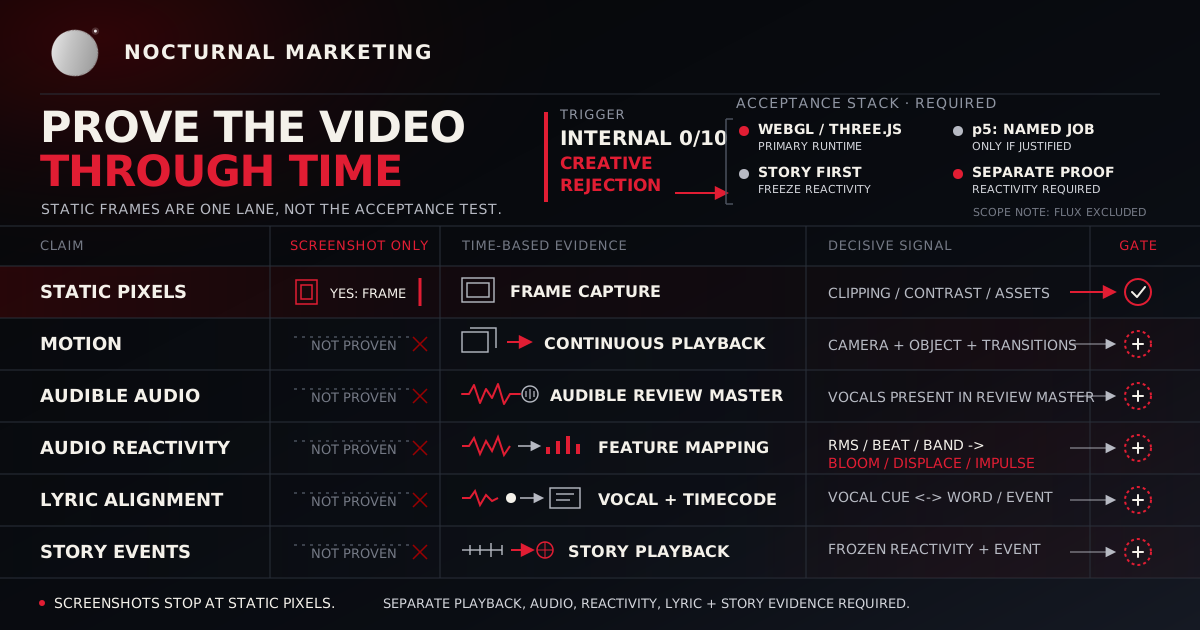
Proof scope: Internal Nocturnal creative acceptance model checked July 28, 2026. The matrix shows which evidence can verify each claim. A screenshot stops at static pixels.
The expected invariant
Our expected invariant was simple: a valid candidate should remain recognizable as the same authored music video at every review point.
The opening establishes a visual world. Verses develop it. Choruses change its scale or pressure. Lyric events alter space according to meaning. Audio features shape motion already designed into that world. The ending resolves something introduced earlier.
A reviewer should be able to select any meaningful timestamp and answer four questions:
- What part of the song are we in?
- What changed in the visual story?
- Which musical or lyrical event caused that change?
- Will the same input produce the same result again?
That invariant joins creative intent to technical repeatability. Break either side and the candidate is incomplete.
The observed failure
The rejected candidate cleared technical validation and earned a 0/10 in creative review.
It presented clean surfaces and valid rendered frames. The composition had enough polish to resemble a product advertisement: centered hero objects, controlled lighting, readable labels, and moments that could survive as campaign stills.
Across the full track, the piece had no convincing story progression. Lyrics behaved like overlay content. Reactive movement looked decorative. The visual system repeated effects without building tension, changing meaning, or resolving an idea.
This created a dangerous false positive. A team reviewing build health could approve it. An artist watching the full song could reject it within minutes.
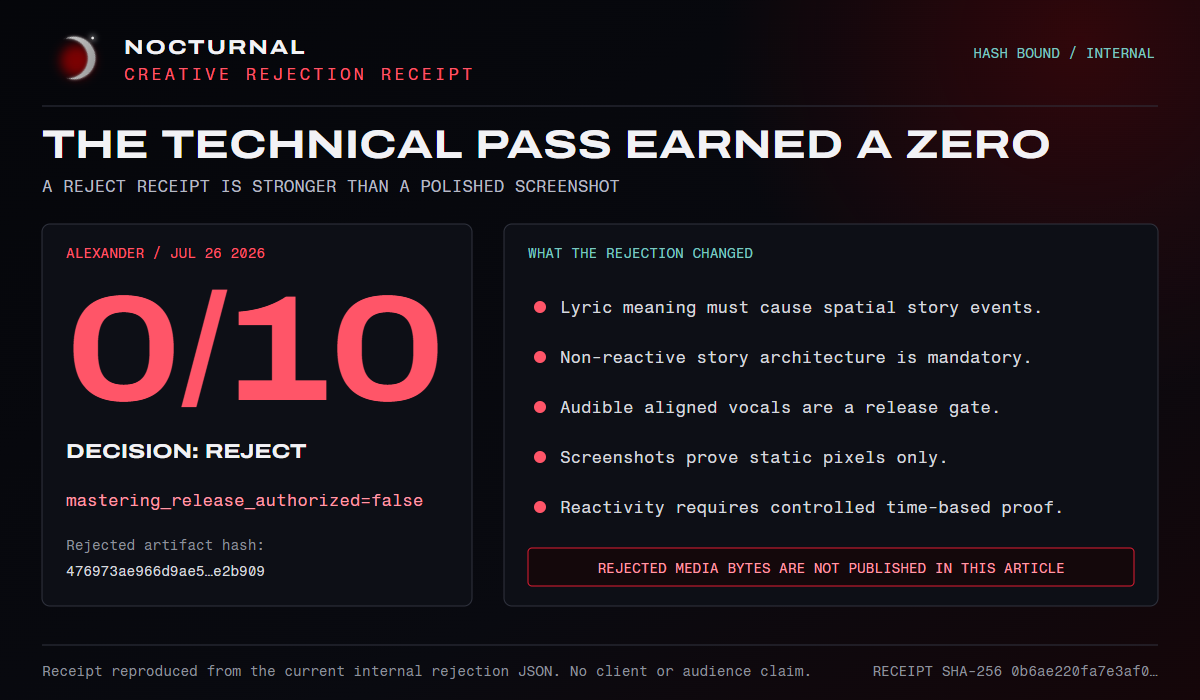
Evidence receipt: The visual reproduces the current internal rejection JSON and its bound rejected-artifact hash. The rejected media bytes are not published in this article, so this receipt proves the decision and changed contract rather than asking a static image to prove temporal quality.
Why the technical checks missed it
Technical checks answer bounded questions. Does the scene start? Do assets load? Are frame dimensions correct? Does a timestamp render? Does the audio analyzer return values? Those checks matter, but their scope ends at system validity.
Creative acceptance asks different questions. Does the visual decision fit this lyric? Does the chorus earn a larger spatial event? Can a viewer follow the emotional movement of the song? Does reactivity sharpen an authored choice?
A screenshot cannot answer any of them. Screenshots prove static pixels only. They can expose clipping, contrast, spelling, composition, and missing assets at one instant. They cannot prove movement, rhythm, lyric timing, vocal audibility, continuity, or reaction to sound.
The format distinction matters too. Product advertisement surfaces optimize for recognition, claim clarity, product framing, and a direct action. Full music-video creative has to sustain emotional progression across an entire track. It needs motifs, variation, lyric interpretation, pacing, and payoff. A strong advertising frame can live inside a music video, yet a sequence of advertising frames will not create one.
The creative and business consequence
A false pass wastes the most expensive review cycle. Engineering time, render time, artist attention, and launch planning collect around a candidate that never had the right creative structure.
The artist pays first. Their song gets reduced to a demo reel for effects. Words appear on screen without affecting the world around them. Performance energy gets buried under visuals that react to amplitude while ignoring meaning.
The business pays next. Approvals slow down because each reviewer is grading a different artifact. Technical staff defend runtime validity. Creative staff reject the experience. Marketing extracts stills that look ready while the full video remains unusable. The disagreement becomes costly because the acceptance standard was never shared.
A written contract fixes the review surface. Everyone sees the same gates before production expands.
The implemented acceptance standard
We replaced the broad instruction to "make it audio reactive" with six required gates.
Lyric meaning creates spatial story events
Lyrics need consequences in the scene. A line about distance can separate forms, camera planes, or fields of light. A line about pressure can compress the frame. A repeated phrase can return an earlier object with changed scale, position, material, or behavior.
Literal illustration is optional. Causal relationship is required. The reviewer should be able to connect the lyric to the spatial event without reading a production note.
WebGL or Three.js owns the primary runtime
The primary visual system runs in deterministic WebGL or Three.js. Given the same song, timeline, seed, and configuration, it should reproduce the same scene state at the same timestamp.
Determinism gives directors a stable target. It makes revisions comparable, supports frame-accurate review, and prevents a good take from depending on an unrepeatable accident.
Every p5.js layer earns its place
A p5.js layer can handle typography, procedural marks, masks, textures, or a deliberately different drawing language. It needs a named job and a reason to sit outside the primary Three.js scene.
A layer fails this gate when it duplicates existing runtime work, hides weak composition, or adds motion with no relationship to the story. p5.js remains useful when the layer expands the visual grammar and survives a direct before-and-after review.
Story leads the non-reactive architecture
The story-led non-reactive architecture must read with audio modulation frozen. Scene changes, camera movement, object entrances, lyric events, motif returns, and transitions should already form a complete timeline.
Audio reactivity then adjusts authored parameters such as displacement, bloom, particle pressure, material response, or camera impulse. This sequence protects the piece from becoming an equalizer with expensive shaders.
Vocals stay audible and aligned
The review master must contain audible vocals. Lyric text, spatial events, and performance accents need to align with the vocal take a listener can hear.
A muted proof, an instrumental proxy, or a waveform-only render cannot establish lyric alignment. Reviewers need the same audible relationship the audience will receive.
Motion and reactivity receive separate proof
Motion proof demonstrates that the scene changes over time. It should show camera travel, object behavior, transitions, lyric events, and continuity across representative sections.
Reactivity proof demonstrates that controlled audio features change specified visual parameters. The test should hold the timeline constant, alter or isolate an input feature, and record the resulting visual difference.
Combining both into one montage makes failure hard to diagnose. Separate evidence reveals whether the candidate has authored motion, actual audio response, or only one of the two.
Adversarial proof before approval
A fair-weather demo shows the strongest eight seconds. Adversarial proof tests the exact places where a weak candidate can impersonate finished work.
Run these challenges against the same build:
- Freeze reactive inputs and play the timeline. The story, lyric events, and major motion should remain clear.
- Hold the timestamp and vary one audio feature. Only the mapped visual parameters should change.
- Seek to the same timestamps in two fresh runs. Scene state and lyric state should match.
- Listen without looking at the lyric sheet. Vocals should be audible, and visible words should land with the heard performance.
- Review a verse, chorus, bridge, and ending as continuous motion. Each section should have a distinct dramatic job.
- Compare the motion proof with the reactivity proof. Each artifact should establish its own claim without borrowing credit from the other.
Record the input, timestamp, expected behavior, observed behavior, and pass decision for each challenge. A useful proof packet shows failures too. Failed evidence makes the next repair specific.
The five-check buyer and artist diagnostic
You do not need source-code access to reject a weak audio reactive music video. Ask for these five checks before approving the final render.
- Lyric consequence: Can the creator point to a lyric whose meaning changes the space, object behavior, camera, or recurring motif?
- Repeatable runtime: Can the creator render the same timestamp twice from the same inputs and produce the same scene state?
- Layer justification: Can the creator explain what each p5.js layer contributes and show the piece with that layer removed?
- Story with reactivity frozen: Does the full timeline still develop when audio modulation is held constant?
- Complete proof: Do you receive audible aligned vocals, continuous motion evidence, and a separate controlled reactivity test?
One failed check identifies a repair area. Several failed checks signal a prototype that is being presented as a finished creative.
Methodology and internal-development disclosure
This article describes an internal Nocturnal development case. The 0/10 score was an internal creative acceptance decision on a candidate build. It was not a client rating, public review, audience study, or commercial performance result.
We use the case because the failure was unusually clear: technical validity created confidence that full-song creative review did not support. The six-gate standard above is the process change implemented after that rejection. It defines production acceptance inside this workflow and does not claim that one visual architecture fits every artist, genre, or campaign.
Build the proof with the video
Proof belongs in the production plan. Waiting until the final render forces buyers and artists to reconstruct intent from a polished file after the budget has already been spent.
Nocturnal's services connect creative direction, deterministic runtime work, lyric treatment, and acceptance evidence. The engagement starts by defining what the song needs to mean on screen and what evidence will make approval defensible.
What to measure after the new acceptance contract
| Measure | Claim it supports | Evidence required |
|---|---|---|
| Repeatable frame state at sampled timestamps | Deterministic runtime | Two fresh renders from identical inputs |
| Lyric events inside alignment tolerance | Audible lyric timing | Actual vocal alignment plus rendered event timestamps |
| Parameter change under isolated audio input | Audio reactivity | Controlled A/B input and visual delta |
| Story continuity with modulation frozen | Non-reactive authored architecture | Continuous playback with reactive lanes held constant |
| Artist or buyer acceptance score | Creative approval | Review bound to the exact audible master hash |
| Decode, frame rate, dimensions, loudness, and channels | Delivery validity | Media probe and full-decode receipts |
Keep these measures separate. A deterministic frame match cannot prove lyric meaning. A high artist score cannot prove decode integrity. The delivery packet needs both.
Frequently asked questions
Audio-reactive music video FAQ
Make the video prove its own creative system
Bring the track, lyric sheet, visual references, and current candidate. Nocturnal will define the story events, runtime boundaries, and proof gates before the next approval cycle.
Build the Acceptance Plan