If you run a local business, you've probably heard some version of this over the past year: "Nobody Googles anymore. Everyone asks ChatGPT. You need to show up in AI answers or you're invisible."
It's a scary pitch. New research built on real ChatGPT conversations suggests it points small businesses at the wrong place first.
This week Rand Fishkin (@randfish), author of Zero Click Marketing, published that research on the SparkToro blog and shared it on X:
We analyzed 118k prompts from 12k ChatGPT users to answer key Qs: - how often do brands appear? - what % of prompts have commercial intent? - how does usage compare to Google search?
Here's what the numbers say, what they don't, and what we think a small business should do about it.
What the study looked at
The SparkToro report uses data from Verso, an opt-in panel of US ChatGPT users who agreed to share their chat history. It covers 118,163 prompts across 41,961 conversations from 12,321 people between January 1 and October 29, 2026. Rand removed 131 very heavy users whose volume made up 21% of all prompts, so the results reflect typical users.
He's also upfront about the limits. The panel skews younger, female, and lower-income, most panelists were recorded on phones, and it doesn't include API use (software talking to ChatGPT directly). He weighted the panel to US Census targets and reports that no category moved by more than 1.4 percentage points. Treat it as one strong data source, with those caveats in mind.
Three numbers worth knowing
Source for all three: SparkToro, November 17, 2026.
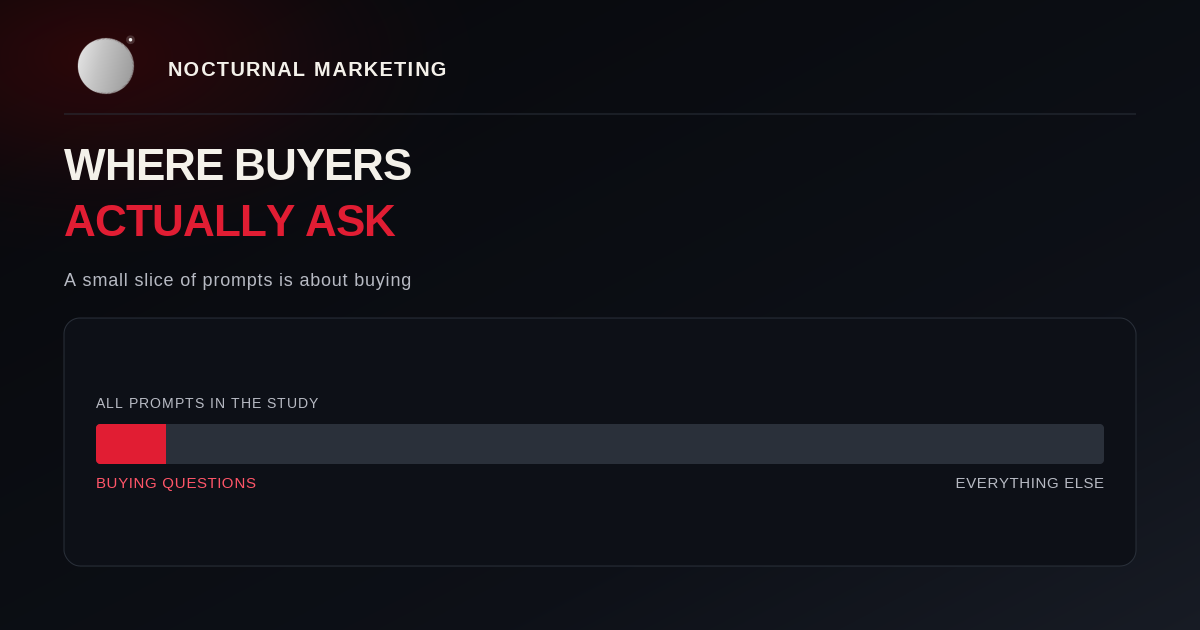
Shopping is a small part of what people ask. The "Shopping, brands & local services" category covers things like comparing products, finding a nearby business, or getting hours and an address. It came to 5.7%. Image making, general curiosity, household tasks, and writing help were all much bigger.
Few answers name a business at all. Only 12.1% of ChatGPT's responses contained one or more brands, products, or companies.
Buying research is rarer on ChatGPT than on Google. Just 6.9% of prompts showed someone researching a brand to buy from. For comparison, Rand notes that when SparkToro looked at 332 million Google queries two years ago, 15% or more matched the same definition.
Rand's read is blunt: "The competition with Google has been massively overblown by marketing press and influencers." And this is the line we'd underline for any owner: "It’s Google and the Google AI Overviews and AI Mode that makes AI visibility so incredibly important and influential."
How marketers reacted
The replies were thoughtful, and a few stood out for small businesses.
@beninthehouse turned the data into a practical rule: "Pick the buying questions your customers ask and measure only those."
That is the useful local move: pick the few questions that turn into calls, and make sure your business gives a clear, trustworthy answer to each one.
What to actually do
AI still matters. The smart move is to put your effort where buyers are and where it pays off twice.
A practical plan for AI search and Google
Start with Google, including its AI features
Write down your buying questions
Answer each one plainly on your site
Make your facts match everywhere
Watch Google Search Console
Then spot-check ChatGPT
Our AI search guide for small business websites covers the basics of step 1, and how to write content AI search can cite goes deeper on step 3.
A note on AI marketing plans
In a separate post this week, Rand asked whether an AI assistant can make a great marketing plan. His answer: "Nope." Then he added, "what if you gave it real audience data, data about where your brand/product is mentioned, and case studies of what's worked in the past? Does that get somewhere exciting?" and answered "Looks like it..." (source)
That matches what we see in SEO work. AI tools are useful for research and drafts. Deciding which questions matter to your customers still depends on real data about your business.
ChatGPT, Google, and small business SEO FAQ
Want to know where you stand
If you'd like a clear picture of which buying questions you show up for in Google and which you're missing, start with our SEO services. SEO starts with a $2,500 audit: keyword research, on-page optimization, backlink analysis and a content strategy. Ongoing SEO is quoted from the audit and runs month to month.
Find out which buying questions you're missing
Tell us what you'd like more customers to find you for. You get a written scope and price, or a plain answer that it isn't a fit.
Start an SEO Audit