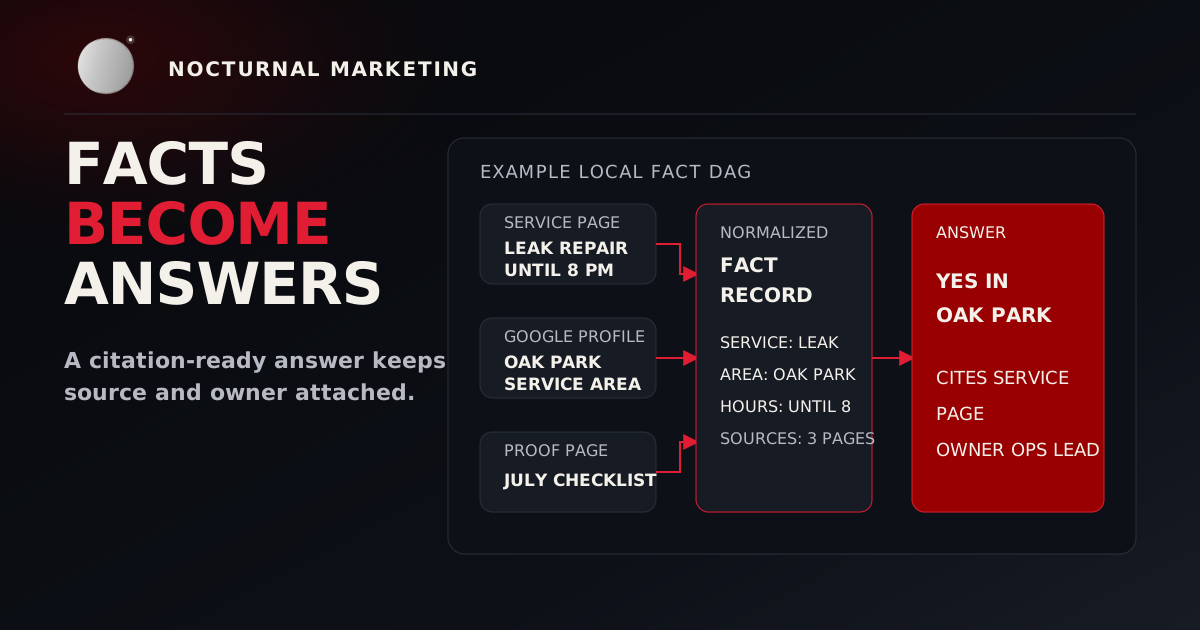
If you are deciding how to write content AI search can cite, build the page as a public source of truth: answer one specific question, show the evidence behind every material claim, identify who created or reviewed the advice, and keep changing facts dated.
That structure helps the human reader first. It also gives answer engines a clean passage to quote without stripping away the conditions that make the advice trustworthy.
Last reviewed: July 18, 2026. Search products and citation behavior change often, so named platform claims below are tied to source notes.
The search intent this page owns
This guide is for the owner, marketer, or operator writing a citable article, service page, guide, or FAQ. It focuses on the editorial system inside one piece of content.
If your immediate problem is whether your business facts are visible across AI answers, start with our AI search small-business website guide. If you are preparing an AI-built website for launch, use the AI website builder production checklist. If this content is part of a broader redesign, pair it with the small-business website rebuild checklist so URLs, measurement, and lead flow survive the rewrite.
The citable-content job is narrower: make one page useful enough for a person to trust and clean enough for an answer engine to quote accurately.
How to write content AI search can cite in six moves
A citable page does six jobs in order.
- It names the exact question and audience.
- It answers the question directly.
- It separates facts from interpretation.
- It connects material claims to visible evidence.
- It shows who created, reviewed, or owns the advice.
- It gives the reader a next action, checklist, or decision rule.
The order matters. A reader should not have to cross a long setup to learn whether the page can help. Answer first, then earn the answer.
Start with a question that has stakes
Weak topic: "AI content strategy."
Stronger question: "How should a small business write a service page that AI search can cite without inventing proof?"
The stronger question has:
- a defined audience;
- a public page type;
- a risk the reader recognizes;
- a decision or method; and
- a testable boundary.
Specific questions create specific answers. They also reduce keyword cannibalization because the page owns a job instead of drifting into every AI search topic on the site.
Put the answer near the top
Give the answer in the first paragraph, then use the rest of the page to prove it. A useful opening often includes the action, the evidence standard, the boundary, and the review rule.
Example:
To write content AI search can cite, answer the target question in plain language, attach important claims to visible sources, add firsthand proof, name the author or reviewer, and update facts when the product, policy, price, law, or platform changes.
That paragraph works even when separated from the page. The rest of the article can explain each clause, add examples, and handle objections.
Build a claim ledger before drafting
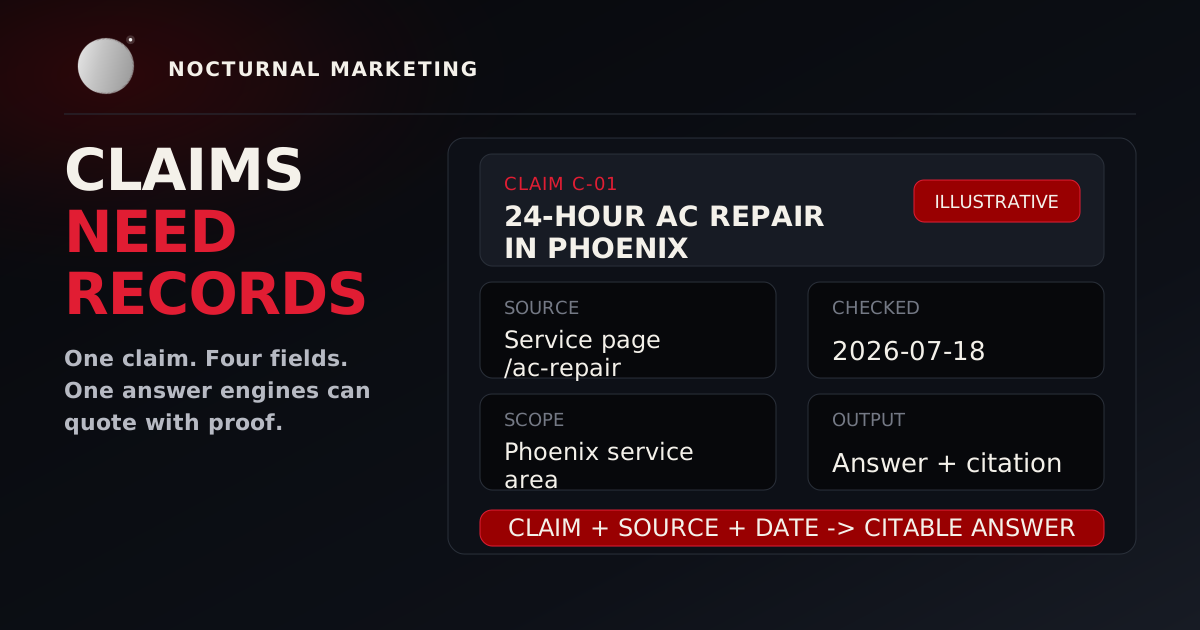
A claim ledger is a simple table that prevents source links from becoming decoration. Fill it before you polish the prose.
| Claim | Type | Best source | Review rule |
|---|---|---|---|
| Google says SEO fundamentals remain relevant for AI experiences | Platform guidance | Google Search Central AI optimization guide | Recheck before publish and after major Search updates |
| This service uses a content review gate | First-party process fact | Current service documentation or internal workflow | Recheck quarterly |
| A customer improved lead quality | Performance claim | Named case record, method, and permission to publish | Verify before publication |
| Clear headings help readers scan the page | Editorial recommendation | Explain the mechanism and test the page with readers | Review during edit |
| Structured data describes visible page content | Technical guidance | Google structured data documentation | Recheck when schema changes |
If a material claim has no defensible source, narrow it, remove it, or do the research. A citable page earns trust by showing what the evidence can support.
Use the citable content stack
Think in layers. Each layer makes the page easier to understand, quote, and share.
| Layer | What the page exposes | Failure to avoid |
|---|---|---|
| Answer | The direct response to the search query | A long warm-up before the useful sentence |
| Entity | Names of products, people, companies, services, and locations | Synonym switching that makes the subject unclear |
| Evidence | Source notes, firsthand artifacts, examples, and method | Citations pasted beside claims they do not support |
| Attribution | Author, reviewer, organization, credentials, and date | Anonymous advice with no owner |
| Structure | Headings, tables, lists, FAQ, and semantic page markup | One large essay that cannot be scanned |
| Action | Checklist, scorecard, template, or next step | Information with no useful behavior attached |
This stack is the working model behind the assigned graphic for this post. It is useful because each layer can be inspected before publication.
Contribute evidence only you can provide
AI search can summarize public pages. Your advantage is evidence from doing the work.
Useful firsthand material includes:
- a real checklist;
- a decision tree;
- an anonymized failure trace;
- a before and after process map;
- a test script;
- a sample handoff document;
- a redacted source ledger;
- a bounded case study with methodology; or
- an expert disagreement explained with conditions.
Experience does not require exaggeration. "We tested five representative inputs and two failed this check" is stronger than a broad claim that cannot be audited.
If customer evidence is unavailable, publish the operating method and its limits. The method can still help a reader and can still be cited honestly.
Make citations do real work
Cite the source closest to the claim. Prefer official documentation, primary research, laws, standards, release notes, datasets, or first-party records. Use secondary analysis when primary material is unavailable, then say what the secondary source can and cannot establish.
A good source note includes:
- the source name;
- the date checked;
- the claim it supports;
- the sample, scope, or limitation when relevant; and
- the action the reader should take if the fact changes.
Example:
Source note: Google Search Central, checked July 18, 2026, says structured data helps Google understand page content and warns against adding structured data for information invisible to users. Treat schema as a visible mirror of the page instead of a hidden claim layer.
That note is longer than a bare link. It is also more useful because the reader knows why the source appears.
Separate fact, inference, and recommendation
Citable content gets weaker when documented facts, editorial judgment, and sales advice blur together. Use explicit labels where the distinction matters.
Fact
Google's Search Central guidance says SEO fundamentals remain relevant for Google's generative AI search features because those features rely on core Search ranking and quality systems.
Inference
A thin second version of a page written only for AI search is a fragile strategy. It adds maintenance risk and can drift away from the page a customer actually reads.
Recommendation
Invest first in accurate public facts, original evidence, crawlable pages, semantic structure, source notes, and measurable next actions.
A reader can challenge the inference without confusing it with the documented fact. That is a trust signal.
Write passages people want to share
AI citation is one distribution path. Human sharing is another. The same page should serve both.
People share content when it gives them a useful artifact or a sharp way to explain a problem. Add one of these:
- a checklist they can copy into a doc;
- a scorecard they can run in ten minutes;
- a table that simplifies a messy decision;
- a before and after example;
- a source hierarchy;
- a glossary of terms customers confuse; or
- a named failure pattern they can show their team.
The claim ledger above is the shareable artifact in this guide. A reader can reuse it before publishing a blog post, service page, sales enablement page, or AI-generated draft.
Use structure honestly
Use clear H2 and H3 headings, short paragraphs, descriptive links, tables for comparisons, numbered lists for processes, and FAQ entries for real questions. Add structured data only when it matches visible page content.
Google's structured data documentation defines structured data as a standardized format for information about a page. It also warns against blank pages created only for structured data and against markup for information the user cannot see.
That principle protects trust. Schema should represent the page. It should never hide proof, reviews, ratings, prices, or claims the visitor cannot inspect.
Keep the page measurable and current
A citable page needs a maintenance path. Add a reviewed date, assign an owner, and set a trigger for updates.
Review the page when:
- the product changes;
- a named platform changes guidance;
- a price, policy, location, credential, or statistic changes;
- Search Console shows high impressions with weak engagement;
- AI search repeats an outdated or incomplete statement; or
- prospects ask the same clarification question after reading.
Google now points site owners to a Generative AI performance report in Search Console for Google's own AI experiences. Cross-platform citation behavior still needs separate checking, but the editorial response starts in the same place: identify the claim, inspect the source, and update the public page.
Frequently asked questions
Sources and verification notes
- Google Search Central: Optimizing for generative AI search. Checked July 18, 2026. Supports the claims that SEO fundamentals remain relevant for Google's generative AI search features, crawlability and index eligibility matter, semantic HTML and page experience are recommended, no special schema.org markup is required for generative AI search, and Google references a Generative AI performance report in Search Console.
- Google Search Central: Introduction to structured data. Checked July 18, 2026. Supports the claims that structured data is a standardized format for page information, helps Google understand content, and should not describe information invisible to users.
- Google Search Central: Creating helpful, reliable, people-first content. Checked July 18, 2026. Supports the claims about people-first content, E-E-A-T, clear authorship, and the absence of a preferred Google word count.
- Google Search Central: Spam policies for Google web search. Checked July 18, 2026. Supports the warning that scaled content abuse includes generating many pages primarily to manipulate rankings while adding little value for users.
Put the standard to work
Our SEO services apply this standard to the pages that should own your searches. When you need new pieces written, content and video covers blogs, email, and web copy, each priced per format before work starts.
Bring the page that needs receipts
Nocturnal Marketing turns content from isolated copy into a working system: source rules, review gates, internal links, measurement, and a next action your team can own.
Diagnose Your Content System