AI search for small business starts with one job: make your website the cleanest public source about what you sell, who it serves, why buyers should trust it, and how a visitor can take the next step.
Search products can summarize, compare, and cite your business before a buyer reaches your site. If your public facts are scattered across old pages, profiles, directories, and social bios, AI answers can repeat the mess. The fix is a source-of-truth website that is accurate for customers and easy for answer engines to quote.
Last reviewed: July 18, 2026. Search products and citation behavior change frequently.
What AI search for small business means
AI search optimization is the work of making your business understandable when a search product generates an answer instead of sending every user through a list of blue links. For a small business website, that means clear entities, accurate service facts, original evidence, clean technical access, and a conversion path that still works after the click.
Google's current guidance keeps the bar practical. It says valuable, non-commodity content, crawlable pages, semantic HTML, useful media, and a good user experience matter for generative AI features in Google Search. It also says Google Search does not use llms.txt, AI text files, special markup, or Markdown files as ranking advantages for AI experiences.
That distinction matters. Use answer-ready structure because readers need quick, accurate answers. Use source notes because claims need proof. Use FAQs because real buyers ask follow-up questions. The strategy works when it improves the page for humans first.
Why small businesses should check now
Squarespace published a July 2026 study based on 1,041 small-business owners, traffic patterns across millions of websites, and 1.3 million AI citations analyzed with Peec AI. Nearly six in ten surveyed owners said they did not know where to start with AI search optimization, over two-thirds had not checked how their business appeared in AI answers, and 40% of owners who had checked found incorrect information.
Those figures come from one company-run study. Treat them as directional market evidence. The operational lesson is still concrete: inaccurate public facts create inaccurate answers, and small businesses usually have fewer spare impressions to waste.
The response is an accuracy audit. You do not need to chase every AI platform on day one. Start by making the public record cleaner than the summaries built from it.
Build the source-of-truth layer first
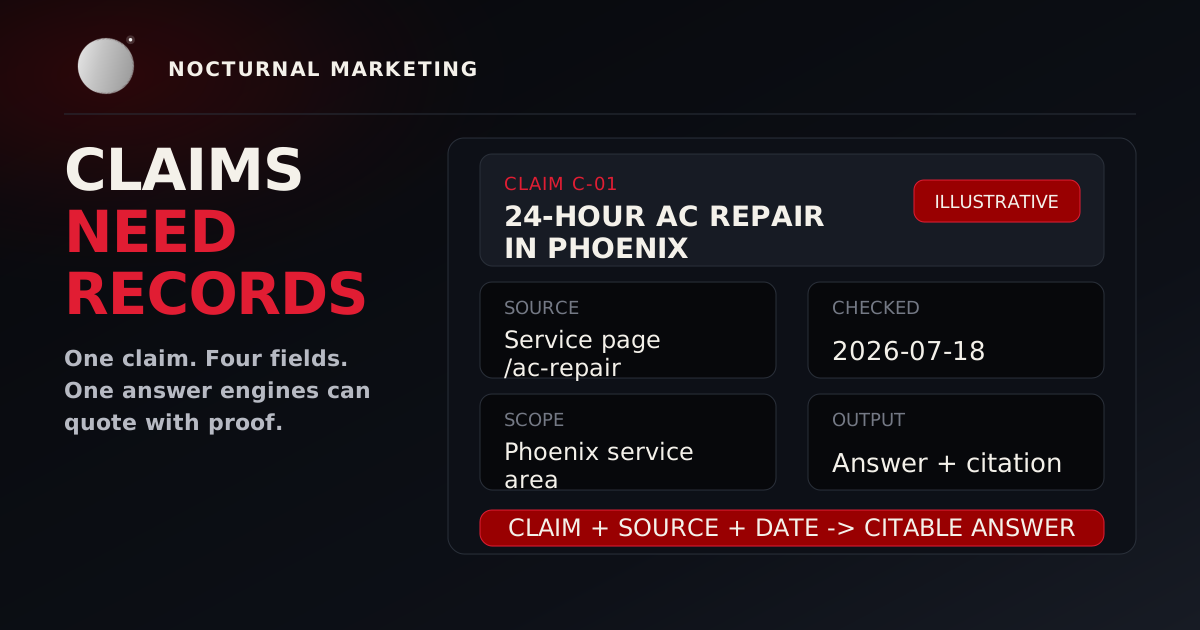
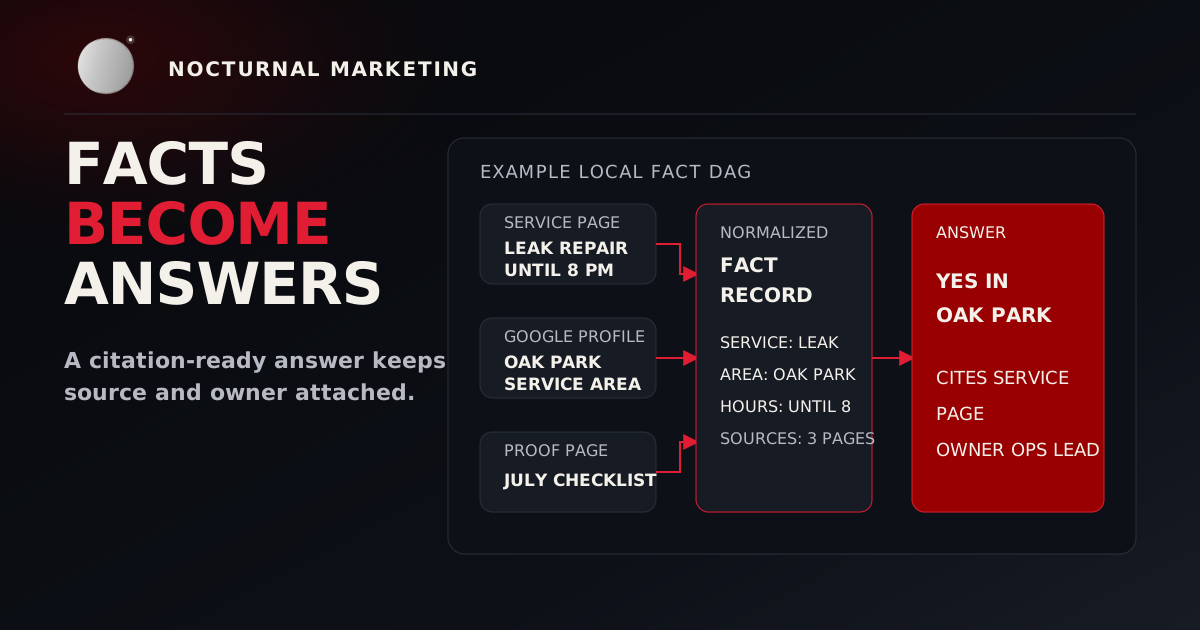
Before you ask ChatGPT, Gemini, Perplexity, Claude, or Google what they know about your business, document what the correct answer should be. A simple internal fact sheet gives your team a standard for every page, profile, and directory update.
Create the source of truth
Write the canonical facts
Map every public source
Mark every contradiction
Fix the strongest source first
Assign an owner
For local and service-area businesses, Google Business Profile is part of that source layer. Google's own help center says a verified Business Profile helps owners maintain accurate business hours, website, phone number, location, products, services, and links on Google Maps and Search. Google's AI guidance also says Google Business Profiles can help products and services appear in AI responses and other Search results where appropriate.
The seven website signals AI search can quote
1. Give each page one clear job
A page titled "Solutions" that mentions twelve unrelated services forces readers and search systems to guess. Each important service should have a page that states the problem, who has it, what you do, how the process works, what the buyer receives, what you do not promise, and the next step.
This is where AI search overlaps with conversion. Clarity helps a search product summarize the page, and it helps a buyer decide whether to contact you.
2. Answer before you expand
Do not make a visitor cross three paragraphs of setup to find the answer. Open the page with a direct answer, then explain the mechanism, tradeoffs, examples, and next actions.
For example:
A custom website is worth pricing when your sales or service workflow requires integrations, permissions, unique data, or measurable handoffs that a template cannot support.
That answer can stand on its own. The rest of the page can define each condition, show examples, and explain the risk of choosing the wrong build path. For article-level structure, use our guide to writing content AI search can cite.
3. Add first-hand evidence
Generic summaries are easy to produce and hard to trust. Add material that could only come from doing the work:
- the checklist you actually use;
- a screenshot with sensitive data removed;
- a failure mode and how it was caught;
- the decision rule behind a recommendation;
- a sample deliverable; or
- a bounded case study with dates and methodology.
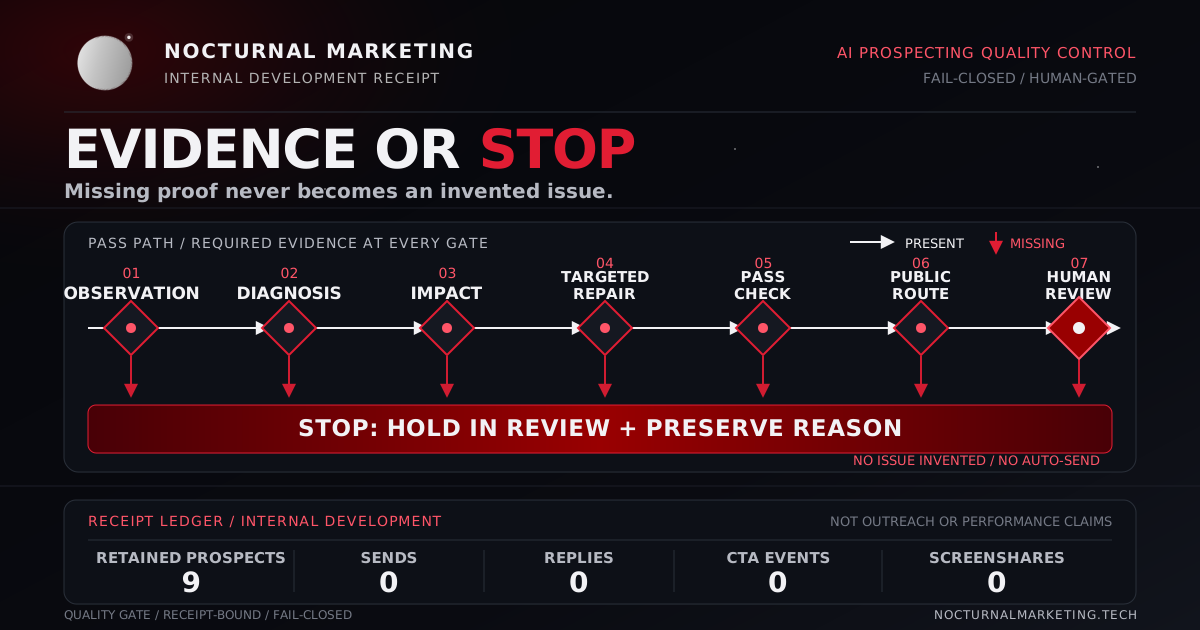
Do not manufacture a customer story. A transparent process artifact beats a fictional testimonial.
4. Make expertise inspectable
EEAT means experience, expertise, authoritativeness, and trustworthiness. It works only when the page shows who wrote or reviewed it, why they are qualified, when the page was reviewed, which sources support changing facts, what is opinion, and how readers can report an error.
The strongest trust signal for a small business is often specificity: a named process, a real deliverable, a clear limitation, and a next step that matches the promise.
5. Use structured data only when it matches the page
Structured data can help search systems understand page content and qualify pages for rich results. Google's structured-data rules are clear: do not add structured data for information that is hidden from users, and do not create empty pages just to hold markup.
Use schema for real entities and visible content: Organization, LocalBusiness, Service, Article, FAQPage, BreadcrumbList, Product, Review, or Event when the page actually supports it. Ordinary marketing claims should never be marked up as reviews, ratings, or FAQs.
6. Keep the technical foundation legible
Use descriptive titles, one primary heading, meaningful subheadings, semantic HTML, descriptive links, useful image alt text, canonical URLs, fast pages, and accurate status codes. Verify that important copy appears in the rendered page without requiring a click, hover, login, or broken script.
Technical SEO cannot rescue weak content. Weak implementation can still hide strong content. If you are rebuilding, run the small-business website rebuild checklist before launch. If an AI website builder produced the first draft, run the AI website builder production checklist before publication.
7. Measure the journey after the citation
AI search visibility has business value only when the visitor can complete the next action. Track landing page, referring source where available, calls, forms, downloads, qualified actions, failed submissions, response time, and the questions prospects ask after reading the page.
The last item is content research. Repeated clarification questions show where the website is still vague. If form submissions disappear after the click, use our lead-handoff test before buying more traffic.
What to fix first when AI answers are wrong
Use the wrong answer as a diagnostic report. The fastest fix is usually the source with the clearest authority over that fact.
| Wrong AI answer | Fix first | Then check |
|---|---|---|
| Business name, hours, location, or phone number | Contact page and Google Business Profile | Directory listings, social bios, booking tools |
| Service description or who you serve | Service page with a direct answer and proof | Homepage, proposal templates, marketplace profiles |
| Pricing model or offer scope | Pricing or service page with current limits | FAQs, sales decks, old PDFs, email templates |
| Founder, license, certification, or reviewer detail | About page or author/reviewer block | LinkedIn, directory profiles, press mentions |
| Customer outcome or proof claim | Case study or process artifact with source notes | Testimonials, screenshots, old landing pages |
| Lead path or contact promise | Contact page, form routing, CRM owner, and response SLA | Analytics events, confirmation emails, spam folders |
Fix the canonical source first. Then update the profiles that repeat it. If you only correct the AI answer in one product, the next crawl can still rediscover the old contradiction elsewhere.
A 30-minute AI search visibility check
Do this before buying a new tool.
- Write five questions a buyer asks before contacting you.
- Search those questions in the AI search products your customers actually use.
- Record whether your business appears, which page or source is cited, and what is inaccurate.
- Compare each answer with your canonical fact sheet.
- Fix the clearest source error first.
- Recheck monthly and after major site changes.
Do not treat one prompt as a ranking report. Answers vary by wording, context, location, account history, and product. The exercise is an error-discovery loop.
What to avoid
Avoid tactics that make the site less trustworthy:
- publishing hundreds of near-duplicate pages for prompt variations;
- hiding instructions for AI systems in customer-facing copy;
- adding unsupported statistics because they sound authoritative;
- marking ordinary marketing copy as reviews, ratings, or FAQs in structured data;
- chasing mentions while your business facts disagree; and
- measuring citations without measuring qualified outcomes.
Google specifically warns against creating separate content variations mainly to manipulate rankings or generative AI responses. More pages do not make a weak source of truth stronger. Better pages do.
Frequently asked questions
AI search for small business FAQ
Sources and methodology
- Google Search Central: Top ways to ensure your content performs well in Google's AI experiences. Checked July 18, 2026. Supports claims about non-commodity content, crawlability, semantic HTML, llms.txt, scaled content abuse, Google Business Profiles, and Google Search generative AI features.
- Google Business Profile Help: Get started with Google Business Profile. Checked July 18, 2026. Supports claims about maintaining accurate business hours, website, phone number, location, products, services, and links on Google Search and Maps.
- Google Search Central: Intro to how structured data markup works. Checked July 18, 2026. Supports claims about using structured data only for visible page content and validating it through Google's Rich Results Test.
- Squarespace: AI Visibility, a Guide to AI Search for Business Owners. Checked July 18, 2026. Supports the cited survey sample, Peec AI citation analysis, readiness gap, and incorrect-information figures. The study is treated as directional market evidence.
Make your website the clean source
Our SEO services start with an audit: keyword research, on-page optimization, backlink analysis, and a content strategy, with pages structured so Google and AI answer engines can quote them. Ongoing SEO runs month to month.
Make your website easier to trust
Nocturnal Marketing builds small-business websites and search foundations with evidence-led content, clean structure, lead tracking, and ownership your team can keep. Bring us the page, form, or AI answer that looks wrong. We will find the weak link.
Audit My Website Source of Truth