Why website leads go nowhere: your website can say "Thanks" while the lead is already gone.
The form works, the thank-you message appears, and the opportunity still dies before a human takes ownership. The failure usually sits in the handoff between form acceptance, storage, delivery, routing, notification, response, and measurement.
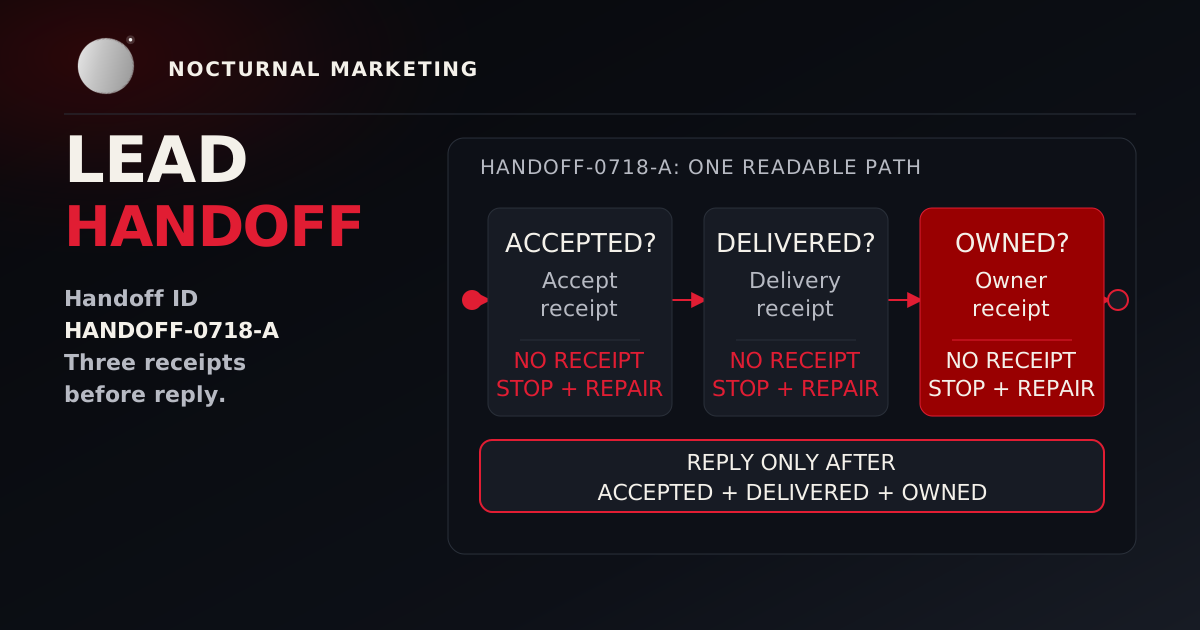
Before funding another campaign, ask for three receipts: the server accepted the submission, the lead reached the intended system, and a named owner had to respond. If your team cannot produce those receipts for one synthetic submission, the funnel is leaking after the click.
The lead path in one line
A complete lead path is:
Intent -> form -> validation -> durable receipt -> delivery -> routing -> owner -> response -> measured outcome
Every arrow can fail. Most dashboards see only the early part: a page view, a button click, or a browser event. The business needs to know whether the right person received a real opportunity and responded inside the promised window.
That is why a website lead audit starts with the handoff. You are checking whether demand becomes an owned conversation.
The three receipts that matter
A controlled lead handoff leaves three receipts before anyone argues about traffic quality:
| Receipt | What it proves | Minimum safe fields |
|---|---|---|
| Acceptance receipt | The server accepted the submission | correlation_id, accepted_at, form_id, source_path, status |
| Delivery receipt | The lead reached the intended system | correlation_id, destination, delivery_status, attempt_count, last_attempt_at |
| Ownership receipt | A person or queue owns the response | correlation_id, owner_role, fallback_owner, response_due_at, first_response_at |
Keep the person's message, email address, and phone number out of analytics. Store sensitive payloads in the protected system that needs them, then use the correlation ID to connect stages.
With only a browser confirmation, you have proof that the page reacted. You still lack proof that the business received a lead.
Why website leads disappear after form submission
The call to action does not match intent
A visitor wants a price range, availability check, service fit answer, or technical next step. The page offers vague language like "transform your future" and gives no clue what happens after the click.
Fix the promise before touching button color. State what the visitor will receive, what information you need, and when a real person reviews the request.
Client side success hides server failure
A form can display "Thanks" after a browser event even when the server rejected the request, timed out, or never received the payload.
The confirmation should reflect a real accepted response from the server. Store a durable receipt before the business promises delivery.
Validation rejects useful people
Strict phone, name, email, or message rules can block legitimate submissions. Weak error messages push the visitor into guessing.
Test real-world variation: long names, international numbers, pasted text, apostrophes, autofill, mobile keyboards, and slow connections.
Email delivery is treated as storage
If the only copy of a lead is an email, spam filtering, mailbox rules, or a provider outage can erase the opportunity.
Store a protected receipt or event first. Delivery can retry from that record. Keep personal information encrypted and retain only what the workflow requires.
Routing rules have no owner
The lead reaches a shared inbox, former employee, disconnected webhook, or CRM queue nobody monitors.
Every route needs a named owner, fallback owner, expected response window, and test schedule. If nobody owns the queue, the queue owns the outcome.
Duplicate protection destroys context
Deduplication helps when the same person submits the same request twice. A blunt rule can discard a second inquiry even when the message, service, or urgency changed.
Define the identity key, preservation rules, and update behavior. Record the new interaction when the contact already exists.
Analytics records a button instead of an outcome
A form_submit event may fire before validation, during a retry, or after a browser script runs while delivery fails downstream. The dashboard celebrates a conversion the business never received.
Measure stages with a correlation ID so the lead can be traced without placing personal information in analytics.
The 15-minute lead handoff test
Use a unique test code such as HANDOFF-2026-07-18-A. Do not use a real customer's information.
Run the handoff test
Open the real path
Check the promise
Submit once
Find the receipt
Trace delivery
Confirm ownership
Check measurement
Close the loop
A pass requires evidence at every stage. "It usually works" is a guess.
Add one controlled failure
A happy-path test proves only the happy path. In a safe test environment, simulate one failure:
- disable the delivery destination
- reject the webhook
- provide an invalid field
- submit twice
- make the downstream service unavailable
Then verify:
- the visitor receives a truthful, useful message
- the submission is not silently lost
- the failure is logged without exposing personal information
- an owner is alerted
- the workflow can retry without creating duplicates
A system that works only when every dependency is healthy is a demo. A business lead path needs recovery behavior.
Use a lead handoff scorecard
Score the handoff by stage. This turns a vague complaint into a fix list.
| Stage | Pass condition | Owner |
|---|---|---|
| Form promise | Page says what happens next | Marketing or site owner |
| Acceptance | Server creates a durable receipt | Developer or platform owner |
| Delivery | CRM, inbox, or webhook receives the same code | Operations owner |
| Routing | Named owner and fallback are visible | Sales or service lead |
| Response | First response sent inside the promised window | Assigned owner |
| Measurement | Accepted submission counted once without personal data | Analytics owner |
Fix the first failed stage before rewriting the whole funnel. A narrow repair beats another broad redesign.
Instrument the stages that matter
Use event names your team can read. For example:
lead.form_viewedlead.submission_acceptedlead.delivery_succeededlead.delivery_failedlead.owner_assignedlead.first_response_sentlead.qualified
A correlation ID connects the events. Analytics receives operational metadata, such as source page, service category, status, and elapsed time. It should not receive the person's message, email address, phone number, or other personal information.
Now the dashboard can separate demand, technical acceptance, delivery, human response, and qualification. Each stage has a different owner and remedy.
Set a response promise you can keep
"We'll be in touch soon" creates uncertainty. A precise promise reduces anxiety only when operations can support it.
Use language such as:
Your request has been received. A project lead reviews new inquiries Monday through Friday and normally replies within one business day.
Then monitor whether the promise is met. If weekends, holidays, or capacity change the expectation, say so.
Specificity persuades because it reduces uncertainty. False specificity destroys trust for the same reason.
Check ownership every week
Once a week, answer:
- How many submissions were accepted?
- How many reached their intended destination?
- How many received a response within the promised window?
- How many became qualified conversations?
- Which stage lost the most records?
- Who owns that stage?
This is a bottleneck review. The point is to find the narrow handoff that needs repair.
When the missing receipt needs integration repair
The scorecard tells you which kind of problem you have. If the form promise fails, the fix is content: a clearer call to action, a stated response window, and a page that says what happens next. That work stays on the page.
If the acceptance, delivery, or ownership receipt is missing, the problem sits in the infrastructure between the form and the CRM. The page can be perfect and the lead still disappears. Diagnose the exact breakpoint before anyone proposes a rebuild. The page, form, and CRM can stay when they already work; the repair targets the step that lost the receipt.
That repair belongs to our website intake and CRM integration service. It traces one known sample from page to owner, preserves the source fields, creates the correct CRM record, routes it to a named owner with a fallback, and records the analytics evidence that proves the path works. For Colorado Springs and Front Range teams, it starts from the same three receipts above.
Source notes for measurement and privacy
The guidance above is operational, but the measurement advice follows official and primary sources:
- Google Analytics says no data should be passed to Google that Google could use or recognize as personally identifiable information. That supports the non-PII correlation ID approach.
- Google Analytics recommends sending defined events with prescribed parameters when you want more useful reports. That supports clear stage names and consistent parameters.
- Google's Search documentation says SEO best practices still apply to generative AI features in Google Search. That supports writing one useful, source-backed page instead of a separate robot page.
- OWASP's Logging Cheat Sheet says sensitive personal data, access tokens, passwords, connection strings, encryption keys, and payment data should be removed, masked, sanitized, hashed, or encrypted before logging.
Frequently asked questions
Website lead handoff FAQ
What Nocturnal checks first
Bring the URL, the form destination, the CRM route, the notification owner, the tracking event names, and the response promise. We build a breakpoint map with five columns: stage, evidence, owner, repair, and retest.
That map keeps the work honest. A failed delivery receipt points to mail, CRM, or webhook repair. A missing ownership receipt points to sales operations. A bad analytics event points to measurement. Different failures need different fixes. If the same break shows up after an AI agent takes the lead, run the related AI agent handoff test.
Stop paying to feed a broken handoff
Nocturnal Marketing diagnoses the path from customer intent to owned outcome. We build the missing control, verify it with a pass/fail test, and hand over the receipts. Bring us the place your leads disappear.
Trace My Lead Handoff